Those visiting a Korean royal palace for the first time quickly discover that the buildings impress visitors not only through their architecture. The paintings inside also tell stories—and many of these stories are not initially easy for visitors from Europe to understand.
One particularly beautiful example is “Baekhakdo” (백학도, 白鶴圖), the “Painting of White Cranes” in Daejojeon Hall of Changdeokgung Palace in Seoul.

The monumental painting was created in 1920 by the Korean painter Kim Eun-ho (김은호, 1892–1979). It is almost six meters wide and was painted in color on silk. Today, it is part of Korea’s state-registered cultural heritage.
But what exactly are we looking at here—and why are there so many cranes in a mural in a royal palace?

A painting for the royal palace
To understand the painting, we must first know what the building represented.
The Changdeokgung Palace was one of Korea’s most important royal palaces. Daejojeon Hall was a particularly significant part of the palace and was closely associated with the royal couple.
In 1917, Daejojeon was destroyed in a major fire. During the subsequent reconstruction, the interior furnishings were also redesigned. It was in this context that the painting “Baekhakdo” was created in 1920.
This means: The painting is not several hundred years old and has not always hung on this wall. It was newly created in 1920.
And that is precisely what makes the painting historically interesting.
Although it is a modern work from the early 20th century, it draws on a much older tradition of Korean court art.

Sixteen cranes in a nighttime landscape
In the large painting, we see sixteen cranes spread across the landscape.
Some are flying over the water toward us. Others are sitting in pine trees, while still others are standing on the ground. The animals are therefore not all shown in the same pose.
This makes the scene appear lively.
You do not get the impression that sixteen identical birds have been lined up side by side. Each crane seems to have its own moment: one spreads its wings, another rests on a branch, and yet another stands alert in the landscape.
In the background lies a dark, nighttime landscape. Against this dark background, the cranes’ light-colored bodies stand out particularly clearly.

Why are cranes so important in Korea?
To a European viewer, the crane might initially appear simply to be a beautiful bird.
In traditional Korean culture, however, it means much more.
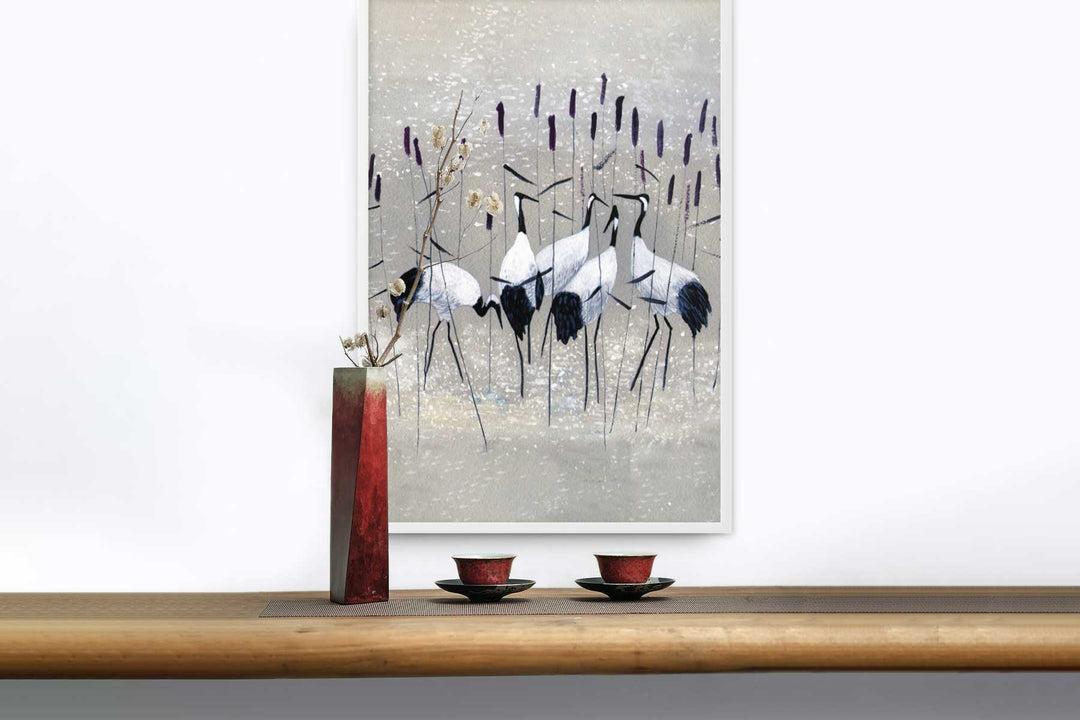
The crane is a symbol of long life and longevity. It is one of the motifs associated in Korean art with the wish for a long and happy life.
An important tradition is the so-called “Sipjangsaeng” (십장생, 十長生)—the “ten symbols of longevity.”
These include various elements of nature, such as the sun, mountains, water, clouds, pine trees, bamboo, cranes, turtles, deer, and the so-called “mushroom of immortality.”
These things were not painted merely because they were beautiful. They represented wishes for health, a long life, endurance, and happiness.
Thus, when a Korean royal palace was decorated with cranes and pine trees, this could simultaneously express a wish for the well-being and long life of the royal family.

Not Just Cranes: An Entire System of Symbols
When you examine the painting more closely, you discover that the cranes do not appear alone.
Pine trees, bamboo, rocks, water, and Yeongji, a traditional motif often associated with the “mushroom of immortality,” are also depicted.
Each of these elements carries a meaning.
The pine tree represents endurance and a long life. It remains green even in winter and therefore became a symbol of perseverance and immortality.
Bamboo is known for its straight growth and resilience and also has strong symbolic significance in East Asian art.
The Yeongji plant, in turn, is one of the traditional motifs associated with longevity and immortality.

The painting is therefore, in a sense, a visual congratulations.
It does not say in words:
“May the royal family live a long, healthy, and happy life.”
Instead, it lets cranes, pine trees, bamboo, water, and other symbols express this message.
And then there are the peonies
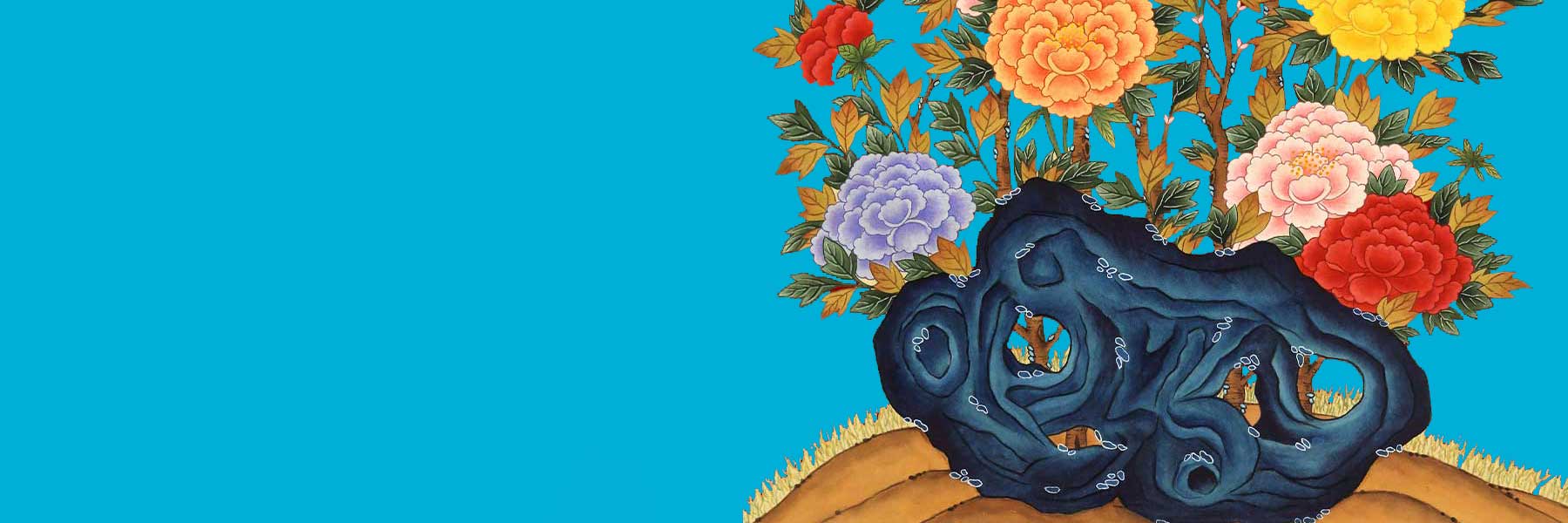
Particularly magnificent peonies stand out along the lower edge of the painting.
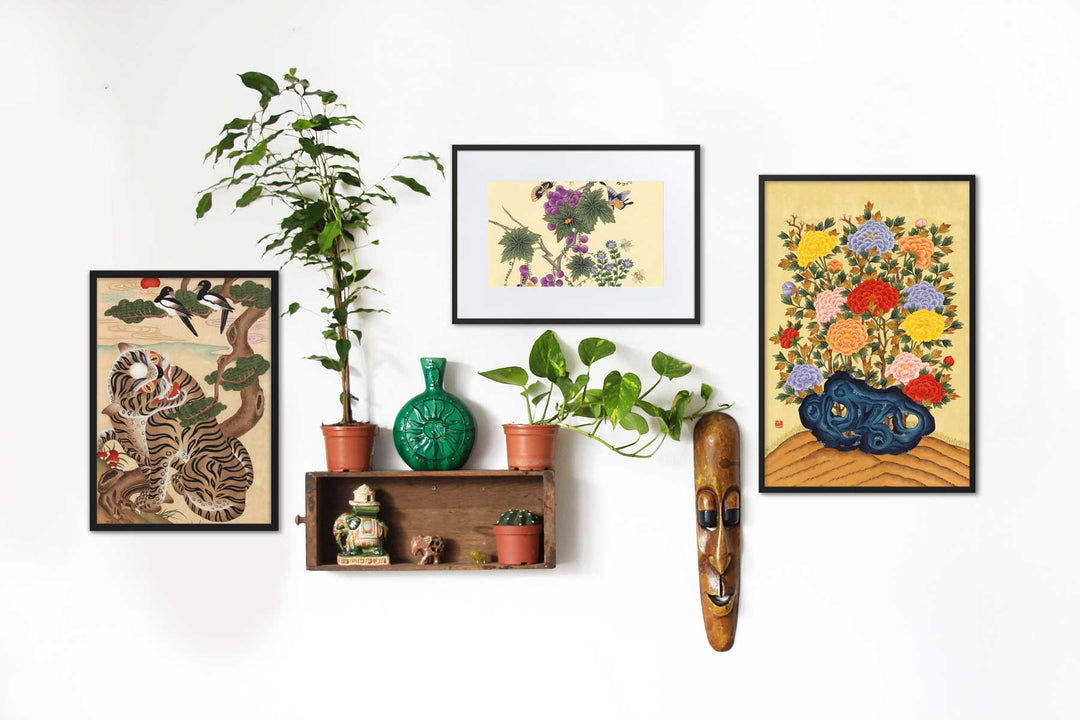
The peony, too, held special significance in Korean court culture. It was associated with wealth, prosperity, and beauty.
This further expands the image’s message.
The cranes wish for a long life.
The pine trees and other plants represent endurance and longevity.
The peonies symbolize prosperity and good fortune.
Together, they create an ideal image of life: long, healthy, peaceful, and prosperous.

An Old Theme in a Modern Painting
What is particularly fascinating is that this painting was created in the year 1920 was created.
The Korean kingdom no longer existed politically at that point. Korea had been under Japanese colonial rule since 1910.
Nevertheless, a painting was created in the former royal palace that deliberately drew on the visual language of the Korean court tradition.
Kim Eun-ho thus used old symbols, but painted them with the artistic means of his own time.
“Baekhakdo” can therefore be understood as a kind of bridge between tradition and modernity.
It is not a painting from the Joseon period. At the same time, it would be wrong to simply regard it as a modern landscape painting.
It shows how strongly the traditional visual language of Korean court art continued to live on into the early 20th century.

Discover this artwork, "Baekhakdo," as a canvas print or as a poster
Kim Eun-ho: Tradition and New Representation
Kim Eun-ho was an important Korean painter of his time.
In “Baekhakdo,” he adheres to traditional symbolism while also trying to make the animals appear as lifelike as possible.
The different body postures and the use of light and shadow are particularly striking.
As a result, the cranes do not appear flat or immobile. Their bodies have volume, and their movements can almost be followed.
Nature, too, was carefully observed.
The pine needles, rocks, stream, and above all the peony petals are rendered in detail.
This shows that Kim Eun-ho not only worked with traditional symbols, but also had a strong interest in depicting nature as convincingly as possible.
A small detail reveals the artist
Those who look closely will spot an inscription on the left side of the painting:
「金殷鎬謹寫」
In essence, it means: “Respectfully painted by Kim Eun-ho.”
His seal is located next to it.
For such a large wall painting, it is interesting that the artist left his personal mark in this way.
The work was intended for a royal space, but at the same time it clearly bears the mark of an individual artist.
A Predecessor to the Tradition
Interestingly, there is evidence that depictions of cranes were associated with Daejojeon even before this painting was created.
A historical account mentions a golden folding screen with seven cranes that was supposedly located in Daejojeon.
However, this does not mean that this old folding screen was the “Baekhakdo” of today.
Rather, it shows that cranes had long been part of the decorative visual language of royal spaces before 1920.
Kim Eun-ho therefore drew on an already established tradition when creating the new painting.
So what should a visitor see in front of the painting?
When standing before “Baekhakdo” as a European visitor, it is worth paying attention to more than just the beauty of the cranes.
The painting can be viewed on several levels.
At first, one sees an impressive natural scene with flying birds, pine trees, water, rocks, and flowers.
Then one recognizes the symbolic dimension:
The crane symbolizes a long life.
The pine tree symbolizes steadfastness and longevity.
The peony symbolizes prosperity and happiness.
And finally, there is the historical dimension:
The painting was created in 1920—a time when the traditional Korean court world was already facing profound political and social changes.
It is precisely this combination that makes the work so interesting.

A wish that lives on in a painting
Perhaps the simplest way to understand “Baekhakdo” is as a painted wish for a good life.
The sixteen cranes fly through the nighttime landscape. The pine trees remain standing upright. The water continues to flow. The flowers bloom.
None of this is accidental.
Here, nature becomes a language.
A language that speaks of longevity, health, prosperity, peace, and happiness.
And although the painting was created more than a hundred years ago, this wish is remarkably timeless.
Perhaps that is precisely why one can still stand in front of “Baekhakdo” for a long time today: one does not need to master the Korean language or know the history of the Joseon Dynasty in detail to understand its fundamental message.
A long life. Health. Happiness. Peace. And the hope that all of this will endure for the people one loves.